IT’S COMPLETELY NATURAL to have questions about vaccine safety, especially when emergency vaccines come on the market.
Here’s what you should know:
- Vaccine development is a closely monitored, rigorous process. Every vaccine, including accelerated emergency vaccines, must meet all safety and ethical protocols.
- Vaccines are based on over a century of research. Vaccine development is not “started from scratch.” All vaccines are developed based on what we already know about safety, immunity, and disease prevention.
- Side effects are well understood. Almost all short-term effects (99.99%) appear within a few weeks. Most long-term side effects arise within 45 days of vaccination. Serious long-term effects are extremely rare.
- Vaccines are the most researched and continually monitored medical interventions in history. They undergo rigorous testing and monitoring before they reach your doctor’s office.
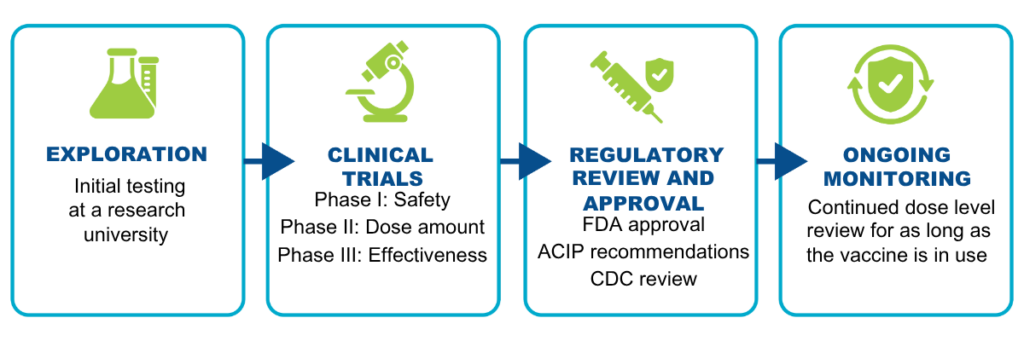
Steps in Vaccine Development
Vaccines work - here's the proof
ONE EXAMPLE is measles, one of the most contagious diseases on the planet

- Before the vaccine, 3 to 4 million people in the United States got measles every year.
- Measles is so contagious that if one person with measles is in a room with 10 unvaccinated people, 9 of them will get sick.
- The measles vaccine drastically reduced risk of infection. When both doses are given, 97% of children will not get measles.
- The United States eliminated measles in 2000, but due to vaccine hesitancy, cases are rising again. Most cases are in people who are not vaccinated.
MEASLES IS NOT THE ONLY DISEASE WE ARE ABLE TO CONTROL WITH A VACCINE.
Some parents worry about the HPV vaccine because they associate it with sexual activity. But here’s the key: the vaccine works best when given between ages 11–13, well before potential exposure. It’s all about building strong protection early, just like other routine childhood vaccines.
Vaccine Safety
VACCINES ARE some of the most thoroughly researched medical advancements in the world. For over 100 years, scientists have been studying vaccines. In that time, billions of children have been safely protected from serious diseases.
Before a vaccine ever reaches your doctor’s office or pharmacy, it goes through an extensive process to make sure it works safely. This process takes years and involves thousands of hours of scientific study. Here’s how it works:

Thousands of people participate in clinical trials to thoroughly test a vaccine’s safety and effectiveness. For example, Pfizer enrolled 43,661 people in its COVID-19 vaccine trial to gather a large amount of safety data.

If a vaccine proves to be safe and effective during clinical trials, the Food and Drug Administration (FDA) reviews it before it’s approved for public use. The FDA only gives the green light if the benefits far outweigh any risks. Plus, dozens of regulatory agencies around the world conduct their own reviews to ensure safety and effectiveness.

After a vaccine is approved, the Advisory Committee on Immunization Practices (ACIP) carefully examines all the data and provides expert guidance on how it should be used to protect people best.
With this rigorous process in place, parents can feel confident that vaccines are one of the safest ways to protect their children’s health.

© Voices for Vaccines. Excerpts and links may be used by websites and blogs, provided that full and clear credit is given to Voices for Vaccines, with appropriate and specific direction and links to the original content. Parents, providers, advocates, and others may download and duplicate toolkits in print, without alteration, for non-commercial use and with full and proper attribution only.
