by Judith Katz, Ed.D.
When COVID arrived, it brought something with it I hadn’t felt in decades: the particular fear of a disease with no cure. I recognized it immediately. I had felt it as a child, in the 1940s and 1950s, when polio stalked every neighborhood in America.
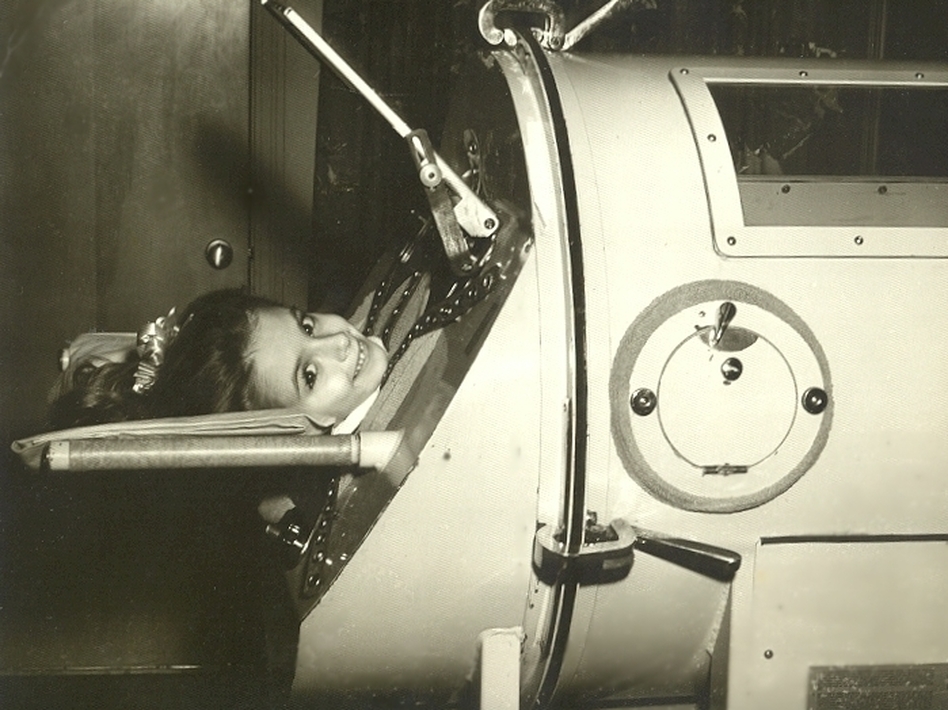
Who can forget the donation canisters near the cash register in every store, with their scary pictures of iron lungs? Summertime became a season of dread for parents. The fear was real, it was everywhere, and there was nothing to do but try to stay out of polio’s way.
Sent Away for Safety
In the summer of 1953, my parents did what fearful parents across America were doing: they sent us away. We went to Camp Delmont, in Livingston Manor, New York — high up in the Catskill Mountains, far from the teeming city and, everyone hoped, far from polio. At our idyllic camp, protecting the children was paramount. Visitors were not even allowed during our eight-week term. Parents who did come up to visit were kept on the outside of camp behind a wire fence. They could only wave at their children and leave packages.
Camp was fun. There were the usual games, color war, and lifelong friendships formed. But fear of polio lurked in the background.
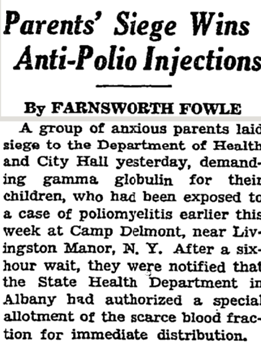
One day, during the seventh week of camp, news spread that one of the camper-waiters, who had taken a day off the previous week, was sick and was being rushed to a nearby hospital. When the result came back that he had indeed contracted polio, the camp called each parent to let them know.
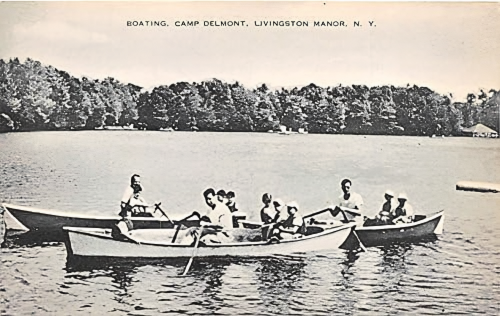
Panic ensued. Parents arrived during the night. Some broke right into the bunks, scooped up their kids, and rushed them to their cars and out of camp. I can still remember how frightened we were. The next morning, a truck brought our camp trunks to our bunks. Counselors instructed us to pack everything up. Later in the day, we tearfully boarded buses back to the city.
We had thought we were safe by going to the country. Ironic. No place was safe.
Home, and Still Not Safe
That summer, we arrived home to find that none of our neighbors would let their children play with us. Then, the only potential treatment for polio was a shot of gamma globulin. Our doctor couldn’t get doses. I remember my father frantically calling other doctors trying to obtain it.
The camp waiter eventually recovered, but walked with a limp for the rest of his life. The camp, too, was never the same. It limped along for several summers after 1953 before finally closing. I visited the area not long ago and couldn’t quite identify where it had been. The camp bunks had been replaced by a housing project.
What the Vaccine Made Possible
Several years passed after that frightening camp experience. Only in 1955, when the highly effective polio vaccine arrived, were we able to finally put the fear of polio behind us.
The numbers tell the story. Poliomyelitis has been difficult to completely eradicate. As recently as 1988, there were 350,000 cases of polio worldwide. By 2013, there were only 407 cases. Today, thanks to the vaccine, Nigeria, Afghanistan and Pakistan are the last polio-endemic countries in the world.
Yes, COVID-19 certainly brought back memories. How fortunate we are to be living in a time when we have access to medical researchers and vaccines so quickly. And those of us who lived through the polio years cannot fathom those who resist the opportunity to be vaccinated against disease.
We know, from lived experience, what it means to be without that protection — and we know how much it means when vaccine protection finally arrives.


Judith Katz is a retired educator, mother, and grandmother living in Virginia. Working as a camp counselor inspired her to become an elementary school teacher. Her story, like all others on this blog, was a voluntary submission. If you want to help make a difference, submit your own post by emailing us through our contact form. We depend on real people like you sharing experience to protect others from misinformation.